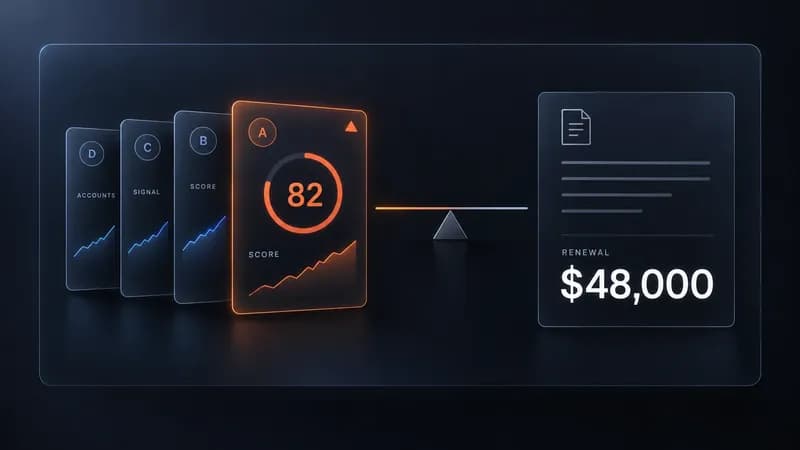
A target account list gets approved in one meeting. Nobody in that room asks how many touches it takes to cover those accounts, or whether the team has the hours. What would you cut if you had to run the arithmetic first?
Somewhere in your pipeline is a deal you lost because the account got a third of the attention it needed. Not because the product was wrong, or the price, or the timing. Because somebody decided that two hundred accounts looked more impressive than forty done properly, and the calendar filled with touches that had no research behind them. That is the failure an ABM strategy exists to prevent, and it is the one it causes most often. The cost never shows up on a report. It shows up as a renewal you did not see coming and a logo that moved to a competitor you had already written off.
What ABM Strategy Is and Where It Sits Against Demand Generation
Account-based marketing means you pick the accounts before you make the offer. A demand engine runs the other way: publish something broadly useful, capture whoever responds, then work out which of them were worth having. ABM inverts the order.
What ABM Means in Marketing Practice
An account-based marketing approach treats a company, not a person, as the unit you plan around. You choose which companies you want, work out who inside them decides, and build content, events and outreach for those specific people. The usual tiering language, one to one, one to few, one to many, describes how much attention each account gets. It says nothing about how many accounts belong in each tier.
ABM is mainstream by adoption. Demand Gen Report's 2026 ABM Benchmark Survey puts roughly 80 percent of organizations running an active program. The strategic question stopped being whether to run ABM. It is which accounts, and how many.
Where it sits against demand generation is settled. Deloitte Digital puts it plainly: ABM "is not a replacement for demand generation and lead capture. It is a complementary strategy that works in concert with demand generation." Demand generation buys the chance to be considered; ABM improves your odds once you are on the shortlist, and the shortlist is where deals get decided. 6sense's 2025 B2B Buyer Experience Report found 95 percent of buyers chose a vendor already on their day-one list.
The two motions are not the same job, and our piece on demand generation vs lead generation explains why the distinction changes a budget. How to fund either one from the top is covered in demand generation strategy. The narrower point: if you cannot name your accounts, you are running demand generation with a smaller list and paying ABM prices for it.
Building the Account List: Fit, Intent, and the Capacity Test
Most lists come out of a filter. Industry equals this, headcount between those numbers, tech stack contains that, exclude customers and competitors. You get a defensible universe and a mediocre list, because a filter cannot tell a fitting company from a ready one.
Fit Is What You Can Observe
Fit is attributes you can verify without talking to anyone: the industry they sell into, the size band they run at, the systems they already use, the roles they are hiring for. If your product saves a team of five a specific job, a company with twelve people doing that job fits better than one with two, and you can see both from outside. A fit-based account based marketing approach starts there, not with a persona document. It is also a different exercise from segmentation and targeting, which gives you groups to address rather than companies to cover.
Intent is the other half. Buyer intent data tells you which fitting companies are researching the problem now, which makes it good for ordering a list and useless for sizing one.
The Buying Group Multiplies the Work
Forrester's State of Business Buying 2026 counts 13 internal and 9 external participants in a typical business purchase, and for GenAI purchases the buying group roughly doubles from 7 people to 14. You are not covering one contact per account. You are covering a room, and the room got bigger while your headcount did not.
The Capacity Math Nobody Runs: Accounts x Touches x Rep Hours

DemandScience already says the disciplined part out loud: "The discipline of tiering is, in part, the discipline of saying no." I agree, and want to add the part it leaves implicit, which is how you find out what to say no to.
Every account needs a set number of personalized contacts a month to stay warm, and every contact costs minutes. Multiply accounts by touches by minutes and you get the hours the list demands. Compare that to the hours the team has, and you have the only list size that means anything.
The model below is a planning assumption, not a benchmark. Replace every number with your own before you use the result. A touch is one personalized interaction with a specific member of the buying group, and minutes per touch include research and follow-up.
Tier | Accounts | Touches per account per month | Minutes per touch | Hours per month | Touches per month |
|---|---|---|---|---|---|
One to one | 12 | 4 | 45 | 36.0 | 48 |
One to few | 36 | 2 | 20 | 24.0 | 72 |
One to many | 72 | 1 | 6 | 7.2 | 72 |
Required in total | 120 |
|
| 67.2 | 192 |
Available to this team |
|
|
| 60.0 |
|
Shortfall |
|
|
| 7.2 |
|
The team here is one marketer plus half a full-time sales development rep, so 60 hours a month on ABM. The list wants 67.2. That is 7.2 hours short, about 12 percent.
Seven hours short is a good result. A team that plans 200 accounts at the same mix is asking for 112 hours against the same 60. Nobody finds that out in month four and fixes it with weekends, because this is not work that compresses. It gets skipped, and the skipped touches are never on the accounts you care least about. They are whichever ones landed on a busy week.
Three fixes exist, each with a price. Cut the one to one tier from 12 accounts to 9 and you land at 58.2 hours, which fits, at the cost of three strategic accounts. Cut the middle tier to one and a half touches and you land at 61.2, still over, at the cost of buying-group coverage where it is thinnest. Add 12 hours of rep time (0.3 of a 40-hour rep) and you have 72 against 67.2. That last one is the honest answer and the one most teams cannot get. N.Rich's 2025 State of ABM found 59 percent of ABM teams blocked by a lack of people and poor data quality, which is the same constraint wearing a different label.
The range holds against what practitioners publish. DemandScience says most mid-market teams can support 5 to 15 accounts at the one-to-one level before engagement quality degrades, and twelve sits inside that. It is not a magic number. It is what falls out of 60 hours, four touches and 45 minutes.
ABM Tactics That Survive a Small Team
ABM tactics are where a small program finds leverage or dies. The test for one is not whether it is clever. It is whether it still works at 120 accounts and 60 hours without collapsing into a template.
Demand Gen Report's 2026 survey found 47 percent naming personalized content as the highest-return tactic, ahead of executive events at 27 percent. Useful, with one caveat: personalized content is expensive in exactly the currency you are short of.
What a Small-Team Version Looks Like
For an account based marketing example you can copy rather than admire, take the least glamorous one available. Pick six accounts from your top tier. For each, write a one-page brief naming the buying group, the trigger you are responding to, and the specific thing you think they should change. Send it to one person with no ask attached. Do it again next month for the same six. That is a tactic, it costs roughly three hours per account per month (four touches at 45 minutes), and it is why a twelve-account tier is possible at all.
The tactics that fail assume volume you do not have. A gifting program across 200 accounts. An intent dashboard nobody opens after week three. None survives contact with 60 hours. Two earn their place: a private page per account showing something nobody else can see, and a roundtable for six accounts instead of a webinar for 600. Both spend hours rather than money, which is why they work.
On AI, Demand Gen Report scored it 7.3 out of 10 for improving ABM outputs, while 43 percent of teams struggled to connect it to their stack. AI carries the research half of a touch well and the judgment half badly, and the judgment half is what a buying group notices.
What to Measure When the List Is Small
Small samples break the metrics most teams bring to ABM. With twelve accounts in your top tier, one closed deal moves win rate by eight percentage points. One lost deal moves it back. You are measuring which deals happened to close this quarter.
Progression is the alternative. Give every account a stage (identified, engaged, in conversation, opportunity, customer) and count how many move one stage forward each month. Coverage is the second measure. If Forrester is right about 13 internal and 9 external participants, contact with two people is a sample of two, not coverage.
Stage definitions sit close to what our guide to marketing KPIs is about, and the funnel mechanics underneath them are covered in lead generation funnels. What matters here is narrower: at 120 accounts a rate is noise and a count is a fact.
The Numbers This Article Will Not Use
One set of ABM statistics follows this subject around, and I am not going to use it. Not because it is inconvenient, but because none of it survives a request for the study behind it.
- Accounts in an ABM program are 1.9 times more likely to beat revenue targets. There is no study. The trail ends at roundups citing other roundups.
- ABM accounts close at 35 percent higher rates. A relative lift with no comparison group named anywhere in the chain.
- ABM shortens sales cycles by 28 percent. The working is 120 days down to 86, which is 28.3 percent, and the percentage reads like it came first.
- 171 percent higher average contract value. It has a real origin, the ABM Leadership Alliance with TOPO, built on about fifty telephone interviews, and it gets attributed to a different body in most retellings.
- 137 percent average ROI. A 2025 panel survey where 771 marketers estimated their own return. That is an opinion poll with a decimal point.
- 75 percent of marketers reporting higher ROI from ABM. Repeated widely, sourced nowhere, impossible to check.
They are not lies exactly. They are numbers that lost their provenance between the fourth and the fortieth retelling. If you need a figure for your board, use one of your own: accounts that moved a stage this month, buying-group contacts reached, hours per account. Those survive a follow-up question.
The adoption data is not uniformly flattering either. In the same 2026 survey, 52 percent of programs met expectations, 23 percent exceeded them and 10 percent greatly exceeded them. That leaves 15 percent that did not, and an honest version of this article starts from the reasons inside those 15 percent.
When ABM Is the Wrong Motion

ABM fails predictably in four situations, none of them fixable with better content.
The deal is too small to pay for the attention. The clearest published threshold is B2B Playbook's: "$10K ACV and above is where ABM economics start to hold up". Below that, the hours per account cost more than the account is worth.
A committee you cannot reach. Security review, a legal entity to invoice, procurement, a processing agreement. If the contract needs three signatures, one personalized contact does not move it.
A market too small to tier. If your addressable market is 40 companies, you need 40 relationships rather than a tiering model.
Sales will not commit. ABM without a seller who shows up is a marketing content project with a bigger budget. ABM Agency and B2B Playbook make that point well; the practical test is whether a named rep will accept a named account as their own.
If two or more are true, stop. Not forever, and not as a verdict on your product. The motion you want is either demand generation with a named-account overlay, or a sales-led motion with a real evaluation path.
Time is the fifth condition, the one people skip. Demandbase's guidance is 6 to 12 months before significant results. If your funding or your patience does not survive twelve quiet months, ABM looks like a failure in month five when it is simply early.
Frequently Asked Questions
Is ABM a Strategy or a Tactic?
It is a strategy, and the distinction matters because tactics are the part everyone copies. A strategy is a decision about where limited attention goes, so it includes what you are declining to do. Tiering is where that becomes visible: an account in the third tier is a choice not to give it first-tier hours. If your plan does not name accounts you have decided not to pursue, it is a campaign plan wearing a strategy label.
How Many Accounts Should an ABM List Have?
However many your hours cover, and no more. Multiply accounts by touches per month by minutes per touch, divide by 60, and compare the result to the hours your team has. In the example above, 60 hours comes 7.2 hours short of 12 accounts at full attention, 36 at reduced attention and 72 at low attention. Cut the one to one tier to 9 and it fits at 58.2. Start from the hours, not from an account count you saw in someone else's deck.
How Long Before ABM Shows Results?
Demandbase's guidance of 6 to 12 months for significant results is realistic for revenue. Earlier signals exist if you decide what they are before you start: buying-group contacts reached, accounts moving one stage per month, the share of tier-one accounts with a completed research brief. If nothing moves in 90 days, the cause is usually list size or buying-group coverage rather than the content.

Size the List Before You Staff the Program
Run your own accounts x touches x minutes against the hours your team has, then keep the list, the buying group and the hours in one place so the arithmetic gets checked against what happened rather than against what the deck promised. The trial starts when you connect.