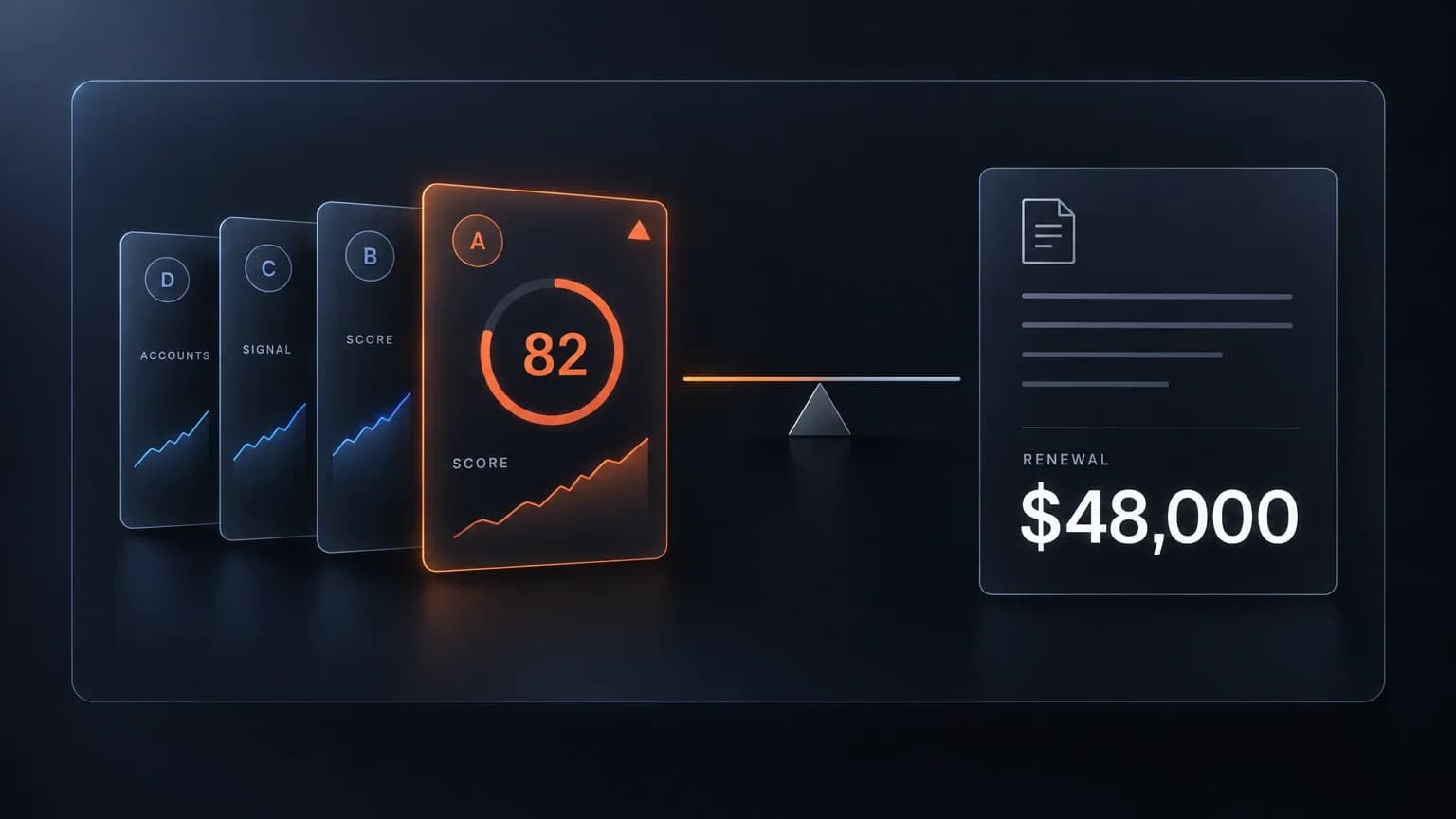
You bought reach and got a list. Nobody wrote down what your team does when an account appears on it, and that unwritten rule is what renews the contract. Can you name one decision the data changed?
The renewal notice for your buyer intent data subscription lands in a quarter where the account score moved twice, and nothing in the pipeline explains either move. What did this line buy last year? The honest answer is a slide with a rising bar and four logos. I have watched that exchange go badly more than once. Nobody in the room can name a single deal the data changed, and the price stops being the question at that point.
The subscription sits in a budget with forty other lines. The question that decides it is smaller than the category argument: did this signal tell you something your CRM did not already know, and did anyone act in time?
What Buyer Intent Data Measures (and What It Does Not)
Buyer intent data is an inference. A source observes something a buyer did, and a model turns that observation into a claim about how close an account is to buying. Everything else on this page depends on how thin that inference is.
The third-party version watches content consumption across a publisher network. An account reads enough pages on a topic, and the vendor raises a score. You get a company name, a topic and a number, not the people or the question they were trying to answer.
The first-party version watches behavior you can already see: repeat visits from one company, documentation pages, a pricing page opened three times. Treat it as the most trustworthy source and the least surprising one, because an account on your site already knows who you are.
The marketplace version watches comparison and review activity. It is the only one of the three that tends to hand you a named person instead of an inferred account, which makes it the easiest to act on and the easiest to over-read.
None of the three reaches the part of the purchase where the decision is made. Forrester's State of Business Buying, published in January 2026, puts the typical decision at 13 internal stakeholders and nine external influencers, with procurement functioning as a decision-maker in 53% of business buying cycles. A topic score is one input into a room you are not in. It cannot tell you whether the project is funded, who argued against it, or which of the thirteen wrote the business case.
That boundary is where the disappointment at renewal comes from. The score was accurate. It described research, and you read it as intent.
The research that never touches a tracked domain is the dark funnel, and all three sources miss it by construction. If your instinct is that this is really an attribution problem, marketing attribution software is where to settle that before you price another subscription.
The Three Signal Types and What Each Actually Predicts
The three sources differ in what they promise, and that difference matters more at renewal than any dashboard does. Here is the honest split, with how long each takes to tell you anything.

Signal type | What it predicts | Time to signal |
|---|---|---|
Third-party topic surge | That an account is reading about a category, not which people are reading or whether a project is funded. Strong on breadth, silent on the decision. | Days to weeks after the research starts, often after the shortlist has formed |
First-party behavioral | That one identifiable company is active on your own properties right now. Cannot tell you who else in the account disagrees, or whether budget exists. | Hours to days, and nearly always late in the cycle, because they already know you |
Marketplace and review activity | That a named person is comparing you against a shortlist. The researcher is identified, the buying group is not. | Days, clustered in the last weeks before a decision |
A topic surge is the easiest of the three to sell and the hardest to defend. Bombora intent data is the product most buyers mean when they use the phrase, and it arrives as an annual contract on a network you do not control. The score shows up days or weeks after the research began, usually after your buyer has a shortlist.
Your own behavioral data is more precise and later. Precise, because one company is doing the thing you can see. Later, because they can only visit a page you publish, so the signal fires after they know you exist.
Review and comparison activity is the closest thing to a person. Somebody put two products side by side, and that happens near the end. Useful for a rep with a phone, nearly useless for a content calendar.
Now put the size of a deal next to any one of those signals. 6sense's 2025 Buyer Experience Report puts the average buying group at 10.1 people and 16 interactions per person with the winning vendor, across a 10.1-month cycle. Do the multiplication and a single deal carries well over a hundred touchpoints. A topic surge is one of them. Expecting one signal to carry a forecast is where the disappointment starts.
Choosing a Signal You Will Act On
B2B intent data providers compete on reach: how many accounts, how many topics, how many contacts, how many publishers in the co-op. Reach is the wrong axis at renewal. You are buying a reason for your team to change what it does on a Tuesday.
Four filters, in this order: recency, frequency, fit, and who inside the account.
Recency. Ask how long after the event the alert reaches you, and ask for the median lag rather than the fastest example on the sales call. A signal that arrives three weeks late is a research artifact, not a trigger.
Frequency. One visit is noise. The same account on the same topic across several weeks is a pattern. Write down how often an account has to appear before your team may act. With no number, nobody is following a rule. They follow whichever alert arrived most recently.
Fit. An account outside your range consumes attention and never closes. Filter for the shape of your closed-won list before you look at the score. A large logo on a topic surge is the most expensive noise you can buy.
Who, inside the account. This is the filter the category underweights. Gong's analysis of 1.8 million opportunities, published in April 2025 and restated in January 2026, found that 77% of deals involve more than one buyer contact, that the deals which close carry twice as many buyer contacts as the ones that do not, and that above $50,000 a multi-threaded deal shows a 130% higher win rate. Gong labels it observational, so read it as a direction. A signal naming one person in a ten-person decision is a hint about where to start, not evidence of a purchase.
Those four give you a rule you can defend: act when a fitting account appears repeatedly, recently, and with a person you can name. Everything else belongs on a watchlist, and a watchlist does not need a renewal.
The Test Before You Renew
Renewal is the one moment when the question cannot be avoided. Run the six checks below against one signal, not the whole platform. Each is pass or fail, and each takes under an hour with your CRM open.
- Name three accounts it surfaced that your CRM did not already have. Pass if you can say three company names out loud and trace each one to the tool before your team touched it. Fail if the list is your existing pipeline, reorganized.
- Show one action taken inside the window the signal is good for. Pass if outreach, an ad segment or a campaign change happened within days of the alert. Fail if the alert went into a channel nobody replied to.
- Find one deal where the surge came before the first touch. Pass if at least one progressing deal shows the signal first and the human contact second. Fail if every match is an explanation written after the deal closed.
- Check who, not just which. Pass if the signal named a person or a role your rep could approach. Fail if every row is an anonymous account and your team is expected to guess who to email.
- Look at the fit of what it returns. Pass if the surfaced accounts resemble your closed-won customers in size, sector and stack. Fail if the list looks like the logos on your website rather than the people who buy.
- Put the price next to the pipeline it touched. Pass if you can state the contract and the closed revenue in the same sentence without flinching. Fail if the number cannot be said out loud in front of finance.
The price belongs beside the test. Vendr's procurement data puts the topic-surge product at a median of $25,000 a year across 35 purchases, ranging from $13,000 to $80,450. The platform runs near $62,000 across 387 purchases, from $11,183 to $176,213. Those are medians across anonymized transactions, not this quarter's list price, so treat the range as the honest part.
Now the verdicts, and they should be written down before the renewal call.
Four or more passes: renew, and take the failing check into the negotiation as a specific ask rather than a general complaint. Two or three: renegotiate, cut scope to the signal type that passed, and stop paying for the rest. One or none, or a fail on checks one and three together: cut it at renewal, because that combination means the product describes your own pipeline back to you with a delay on it.
Whatever number the test produces has to live beside the numbers your team already reports. Marketing KPIs is where that set is defined, and a renewal argument that invents a metric for the occasion will not survive the second meeting.
Intent Data Without a Platform
You can run most of this without buying anything, and for plenty of teams that is the right first year.
Your site and product. Which companies came back three times? Your CMS, your analytics and your form fills answer that for accounts that identified themselves. The queries that brought them there give you a rough topic profile from your own traffic rather than a co-op network.
Your CRM. Closed-lost reasons, the number of contacts on each open deal, and the stage where deals stall. If your own deals with three contacts close more often than deals with one, single-contact activity is the cheapest signal you have.
Your review presence. Who compares you, what they say, and which competitors appear beside you. Public comparison pages are a marketplace signal you can read by hand, for the price of an afternoon.
Your call notes. The same objection in five transcripts is a topic surge you already own, with the buyer's own words attached.
What you cannot build yourself is the account researching your category that has never heard of you. That is the gap the subscription sells, and it is worth naming before you decide whether the gap is worth $25,000.
We built Allable so the first-party half of this lives in one workspace: Search Console, the search terms from your ad account and your published pages sit in the same project, and the agent compares them without an export. That is the half you can start on this week.
Where Intent Data Fits in the Demand Program
Intent data is a capture-side input, and where that line sits in the demand split is settled in demand generation vs lead generation, so I will not re-argue it. What that split assumes is that the inputs arriving on the capture side are worth acting on. Nothing checks that assumption. A subscription that fails the six checks is a budget line that survived because nobody asked it a question.
Frequently Asked Questions
What does buyer intent data actually measure?
Three different things sold under one name. Third-party products measure topic-level content consumption across a publisher network and return an account score. First-party tools measure behavior on your own properties. Marketplace data measures comparison and review activity, usually with a named person attached. None of them measures a decision. They measure research, and the decision happens afterwards, inside a group you cannot see.
How much does intent data cost?
Vendr's procurement data puts the topic-surge product at a median of $25,000 a year and the platform at roughly $62,000. Those are medians across anonymized purchases rather than list prices, and both move under negotiation. The figure that decides your renewal is the one on your notice.
Is third-party intent data accurate?
Accurate about the wrong thing is the usual failure. The reading is often correct: an account really did read about your category. What it cannot tell you is whether that means a funded project, one curious employee, or a competitor's analyst checking your positioning. DemandScience surveyed 750 senior marketing leaders for its December 2025 performance marketing report and found 87% saying their marketing investments produced unreliable or inflated signals, with 26% of those signals converting to qualified opportunities. DemandScience publishes that survey and competes in this category, so weigh the number with that in mind. Your own six checks beat any vendor's accuracy claim.
Can you run intent data without a platform?
Yes, for the first-party half. Your site, CRM and review presence can tell you which known accounts are active, how many people are involved in each deal, and who is comparing you. What you lose is the account that has never visited you and has never heard of you. That gap is the product. Whether it is worth the contract depends on how many of those accounts you can name from last year, and if the answer is none, you are paying for a hypothesis.

Run the test on your own numbers first
Start with the accounts you already have. Ask one question of your own data this week: which companies came back three times, and did anyone call them? Allable puts your search data, your ad search terms and your published pages in one project, so the answer comes from systems you already pay for rather than from a new subscription.